FORMULATION 101: How to Use Benchmark Products Like a Cosmetic Chemist
“Benchmarks are a language. They communicate texture, performance, emotion, and expectation”
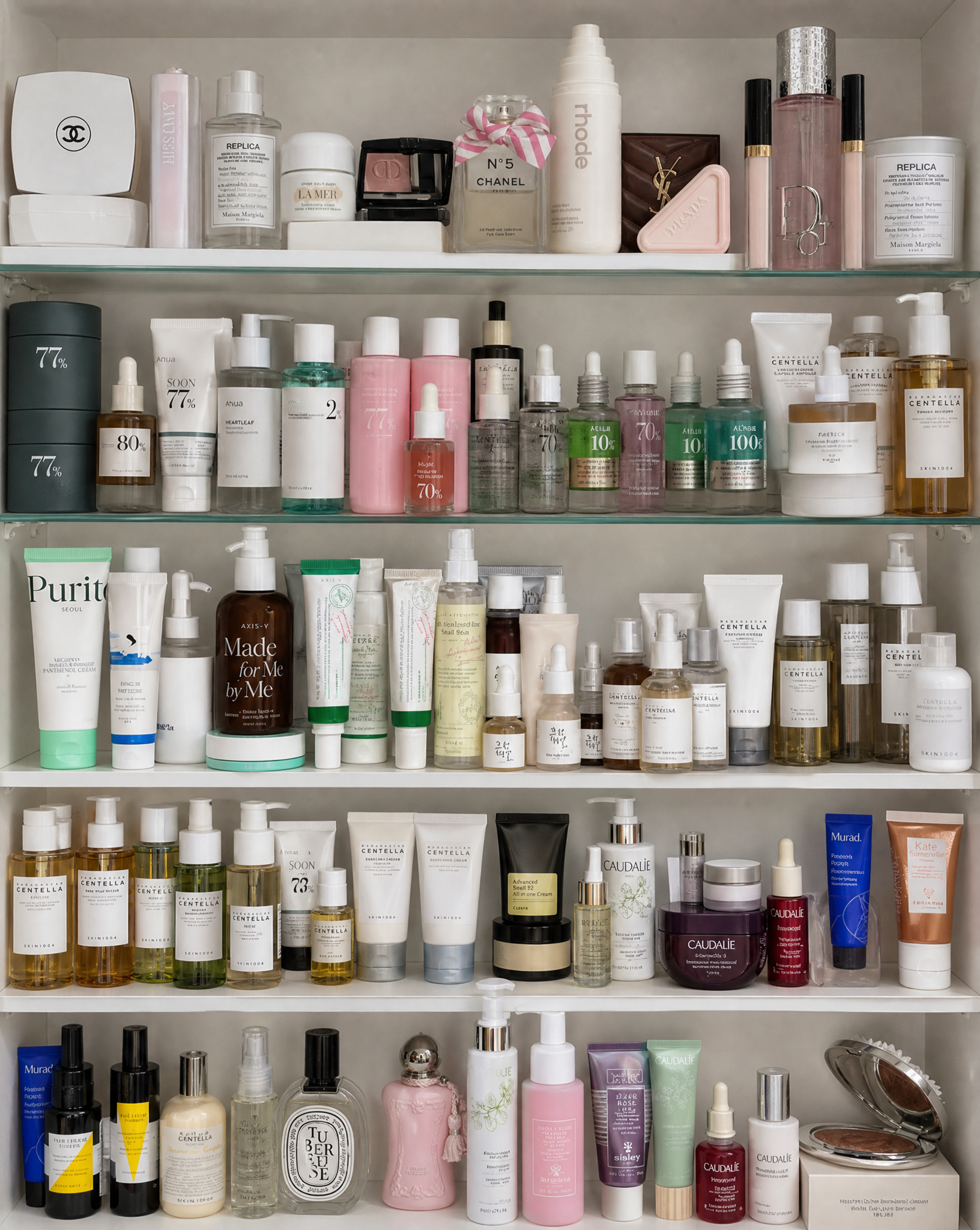
Why the Best Beauty Products Start With Inspiration, Not Imitation
One of the fastest ways to improve your formulation project has nothing to do with chemistry. It starts with benchmark products. Learn how to choose them, communicate what you love (and don't), and help your cosmetic chemist build something uniquely yours instead of simply copying someone else's formula.
Every Founder Wants to Describe Their Dream Product.
Most struggle to explain it.
One of the first questions I ask new clients is surprisingly simple.
"Can you show me a product you love?"
Almost immediately the conversation changes.
Instead of trying to describe a texture as "luxurious," "clean," or "high-end," founders can point to something tangible.
"I love how quickly this absorbs."
"I wish this one felt less greasy."
"This serum is beautiful, but the fragrance is too strong."
"I love the finish on this moisturizer."
Suddenly we're no longer talking in abstract marketing language.
We're talking about experiences.
And experiences are much easier to formulate.
Benchmarking Is Not Copying
This is one of the biggest misconceptions I encounter.
Founders sometimes hesitate to send benchmark products because they worry they're asking me to duplicate another brand.
They're not.
A benchmark isn't a blueprint.
It's inspiration.
Think about architecture.
An architect may admire the windows on one home, the floor plan of another, and the landscaping of a third.
No one expects the finished house to look identical to any of them.
The same applies to formulation.
Great cosmetic chemists don't ask,
"How do I copy this?"
We ask,
"What is the client responding to, and how can we create something even better?"
One Benchmark Is Good.
Three to Five Is Better.
The best projects rarely begin with a single product.
Instead, I encourage founders to send several benchmarks.
Maybe one has the perfect texture.
Another has beautiful fragrance.
A third absorbs exactly the way you want.
A fourth has packaging your customer would love.
A fifth has the ideal finish.
Every product tells part of the story.
Together they paint a picture of what success looks like.
Your chemist can then begin designing something that combines those strengths while avoiding the weaknesses.
Tell Your Chemist What You Actually Like
Sending products alone isn't enough.
The magic happens when you explain why.
Instead of saying,
"Make it like this."
Try saying things like:
"I love how quickly this absorbs."
"I don't like how sticky this feels."
"The fragrance is too strong."
"I want this texture, but with more hydration."
"I love the slip."
"I wish it had less shine."
"I want this sensory experience without silicone."
"I like how this layers under makeup."
"I wish this faded more naturally."
These comments are incredibly valuable.
As cosmetic chemists, we're constantly translating subjective experiences into formulation decisions.
The more specific your observations, the better we can understand your vision.
You're Not Paying for a Copy.
You're Paying for Judgment.
This is where great formulation becomes very different from reverse engineering.
If a founder sends me five benchmark products, my job isn't to recreate one of them.
It's to identify what makes each one successful.
Then I ask questions.
Can we improve stability?
Can we improve skin feel?
Can we reduce cost without reducing performance?
Can we modernize the ingredient selection?
Can we simplify the formula?
Can we make manufacturing easier?
Can we improve sustainability?
Can we increase elegance?
Sometimes the best formulation decision is preserving exactly what makes a benchmark special.
Sometimes it's doing the opposite.
That's why experience matters.
Benchmarks Save Time
Many founders hesitate to spend money purchasing competitor products.
I always encourage them to.
Buying five premium products might cost $150 to $300.
Compared to the investment required to develop a custom formulation, it's one of the least expensive and most valuable parts of the process.
Those products often eliminate weeks of unnecessary revisions because everyone starts the project with a shared understanding of the goal.
That small investment can save thousands of dollars in development time.
Benchmark More Than Texture
Founders often focus only on how a product feels.
That's important.
But there are many other things worth evaluating.
Ask yourself:
How does it spread?
How quickly does it absorb?
Does it pill under sunscreen?
Does makeup apply well afterward?
How long does hydration last?
How does it smell?
How easy is it to dispense?
How does the packaging feel in your hand?
How does the label communicate luxury?
How does the product perform after several weeks?
Every one of these observations gives your chemist another piece of the puzzle.
Don't Benchmark Only Direct Competitors
One of my favorite exercises is looking outside the category entirely.
A hair serum might have the perfect slip for a facial oil.
A luxury body lotion may inspire a sunscreen.
A Korean essence may have the hydration profile you're looking for in a self-tanner.
Innovation often happens when ideas cross categories.
Some of the best formulations I've worked on borrowed inspiration from products that were never intended to compete with one another.
Great formulation isn't about copying competitors.
It's about recognizing great experiences wherever they exist.
The Goal Isn't Similar.
It's Better.
A benchmark product should never become your ceiling.
It should become your starting point.
Ask yourself:
What frustrates me about this product?
What would I improve?
What would make me choose mine instead?
Every answer becomes an opportunity for innovation.
The founders who build remarkable brands don't chase competitors.
They learn from them.
Then they move beyond them.
What This Means for Founders
Benchmarking isn't about asking your cosmetic chemist to recreate another brand.
It's about giving them the information they need to understand your taste, your customer, and your vision.
The better you communicate those ideas, the more time your chemist can spend solving problems instead of interpreting vague descriptions.
Think of benchmark products as a common language.
They help founders describe experiences that are otherwise difficult to put into words.
And that's where great product development begins.
The Cosmeta Perspective
One of the first things I ask new clients is to send me benchmark products.
Not because I want to copy them.
Because I want to understand them.
Every benchmark starts a conversation.
Every observation reveals something about your customer.
Every comparison helps us identify opportunities to create something that doesn't simply compete.
It stands apart.
At Cosmeta, our goal isn't to formulate another version of what's already on the shelf.
It's to understand what made those products successful and build something even better.
Because inspiration is where great formulation begins.
Not imitation.
FAQs
-
A benchmark is an existing product used to define what a new formula should achieve. A cosmetic chemist may evaluate its texture, viscosity, spread, absorption, foam, slip, fragrance, color, packaging, application, afterfeel, and overall consumer experience. The objective usually isn't to copy the formula. It is to translate what the brand likes about the benchmark into measurable development targets for a differentiated product.
-
An experienced chemist can use the ingredient list and physical product to understand its likely formulation architecture, but an INCI list does not reveal the complete quantitative formula, manufacturing procedure, raw-material grades, or exact percentages. Benchmarking is generally more valuable when the goal is to understand why a product performs well and use those insights to create something strategically better.
-
An INCI list tells you which ingredients are declared, but it does not provide the complete formulation. Two products with nearly identical ingredient lists can perform very differently because of ingredient percentages, supplier grades, molecular weights, active forms, processing, emulsification, pH, and manufacturing procedure. This is why cosmetic formulation involves considerably more than reverse-engineering an ingredient list.
-
There is no ideal number. Sometimes one benchmark clearly communicates the target. In other projects, several products are more useful because the founder wants the texture of one, absorption of another, fragrance direction of a third, and performance of another. The goal is not to average competing products together. It is to identify exactly what the brand wants to borrow from each experience and where the new product needs to outperform them.
-
Usually, yes. Strong benchmarks can dramatically improve the development brief before the first prototype is made. They help the chemist understand the founder's sensory expectations while also revealing competitive whitespace, expected price point, claims, packaging conventions, and consumer expectations. The best benchmark isn't necessarily the product you want to duplicate. It is the product that helps define what your formula needs to do better.