In-House vs. Freelance Cosmetic Chemist: Which Is Right for Your Beauty Brand?
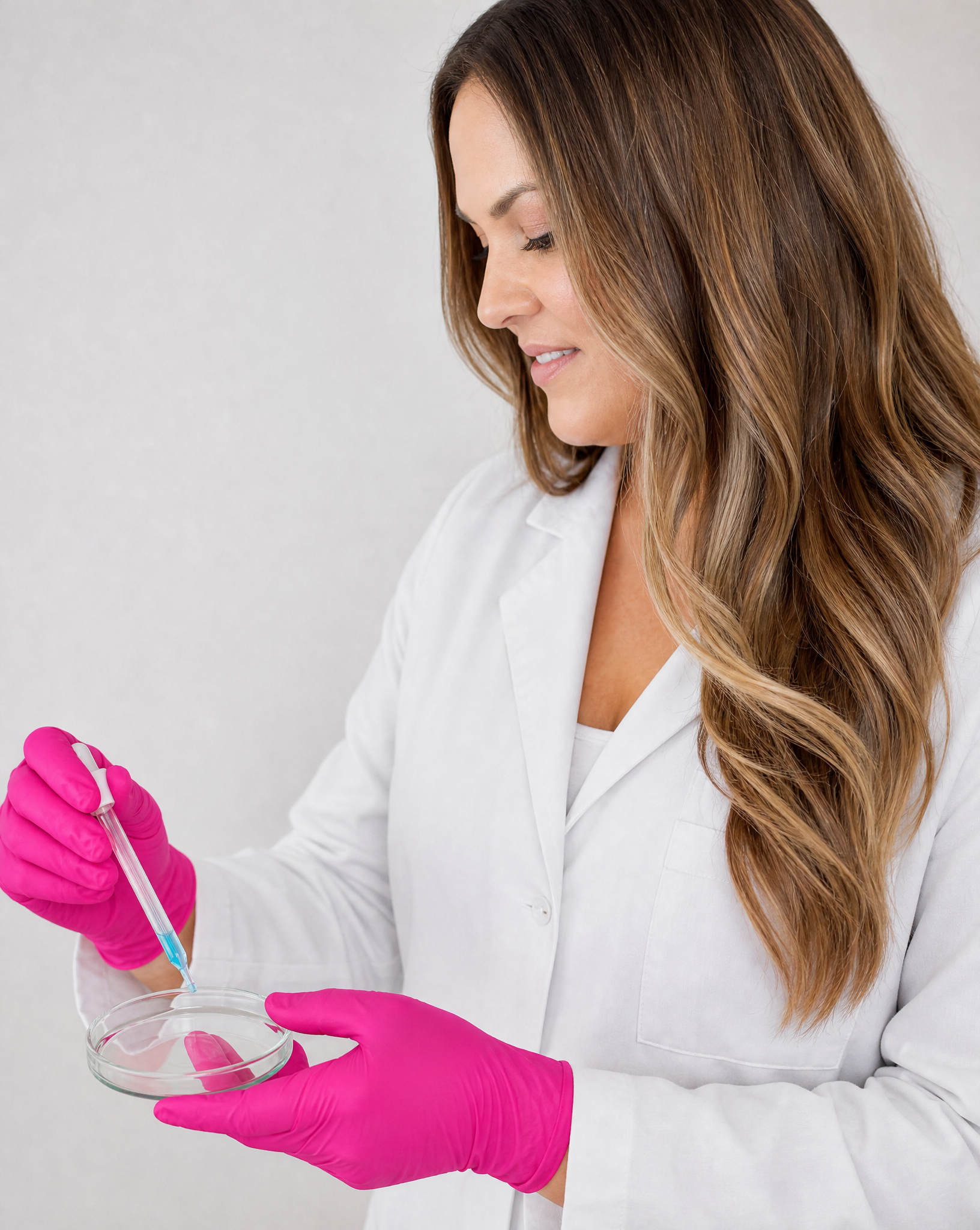
“You don’t necessarily need to employ your own R&D department to develop proprietary products. What matters is having the right technical expertise, a clear development process, and knowing who owns the formula at the end.”
At some point, a beauty brand developing original products has to decide where its formulation expertise will live.
Do you hire a cosmetic chemist and build R&D internally?
Do you work with an independent or freelance cosmetic chemist?
Do you rely on the formulation department of your contract manufacturer?
Or does some combination make more sense?
There isn't one model that is inherently more professional. Major beauty companies maintain substantial internal R&D organizations, while brands of many sizes also use contract chemists, independent laboratories, ingredient specialists, manufacturers, testing laboratories, and other outside technical partners. Industry reporting has documented both models operating side by side.
For most emerging and growing brands, the more useful question isn't simply “Should we hire a cosmetic chemist?”
It is:
How much R&D infrastructure do we actually need to own right now?
What Is an In-House Cosmetic Chemist?
An in-house cosmetic chemist is employed directly by the beauty company and develops products primarily or exclusively for that organization.
Depending on the size of the company, the chemist may work within a larger R&D department or effectively be the R&D department.
Responsibilities can include:
New formulation development
Reformulation
Ingredient research
Benchmarking
Prototype development
Stability evaluation
Technical troubleshooting
Manufacturing support
Raw-material evaluation
Packaging compatibility
Claims and regulatory support
Cost optimization
Large beauty organizations may employ specialists across multiple areas rather than expecting one chemist to do everything.
A smaller brand hiring its first chemist usually has a very different structure.
That distinction matters.
Hiring one cosmetic chemist does not automatically give a company the capabilities of an established R&D organization.
What Is a Freelance or Independent Cosmetic Chemist?
A freelance or independent cosmetic chemist provides formulation and technical services to brands without becoming a full-time employee.
The arrangement is generally project-based or contractual.
A brand might hire an independent chemist to:
Develop one new product
Develop an entire collection
Reformulate an existing product
Benchmark a competitor
Troubleshoot a formula
Evaluate new ingredient technologies
Prepare a formula for manufacturing
Assist with scale-up
Review stability results
Support a contract manufacturer
Serve as an ongoing external R&D resource
Current cosmetic-industry job boards include both conventional staff R&D roles and contract cosmetic chemist opportunities, illustrating that external technical talent is already part of the industry's employment structure.
The word freelance can sometimes make this arrangement sound less substantial than it is.
In practice, an experienced independent cosmetic chemist can function more like an outsourced R&D partner.
The Biggest Difference Is Not Chemistry
Assuming both chemists are appropriately qualified and experienced, the chemistry itself isn't fundamentally different.
The employment model is.
An in-house chemist is a permanent part of the organization.
An independent chemist gives the brand access to R&D capability when the company needs it.
That difference changes:
Fixed versus variable cost
Development capacity
Availability
Infrastructure requirements
Product-development speed
Access to specialized expertise
Intellectual-property structure
Manufacturer relationships
For founders, those business differences can be as important as technical credentials.
When Does Hiring an In-House Cosmetic Chemist Make Sense?
In-house R&D becomes increasingly attractive when formulation is a continuous operational need rather than an occasional development project.
Imagine a company with:
A large existing SKU portfolio
Multiple launches every year
Frequent reformulations
Ongoing cost-reduction projects
Significant manufacturing troubleshooting
Continuous raw-material evaluation
Proprietary research programs
At some point, external project fees are no longer the main issue.
The company needs permanent scientific capacity.
An in-house chemist can work on the brand every day, retain detailed institutional knowledge, react quickly to internal priorities, and collaborate closely with marketing, operations, regulatory, manufacturing, packaging, and leadership.
For an R&D-intensive beauty company, that can be enormously valuable.
An In-House Chemist Can Build Deep Brand Knowledge
One of the strongest arguments for internal R&D is continuity.
An internal chemist can become deeply familiar with:
The brand's sensory preferences
Existing formulas
Preferred suppliers
Ingredient philosophy
Packaging systems
Manufacturing partners
Historical stability issues
Target COGS
Retailer requirements
Product-development pipeline
That accumulated knowledge can make development increasingly efficient.
The chemist already knows that the brand hates tacky serums.
They know which emulsifier system caused trouble during a previous scale-up.
They know the preferred preservative philosophy.
They know which contract manufacturer struggles with a certain process.
They know what “make it feel more like Product X” means without another hour-long briefing.
That institutional memory has real value.
But One In-House Chemist Is Still One Chemist
This is where smaller brands can underestimate what they're building.
Hiring a cosmetic chemist sounds like hiring an R&D department.
It isn't necessarily the same thing.
The chemist needs somewhere to work.
That means some combination of:
Laboratory space
Appropriate ventilation and utilities
Balances
Mixers
Homogenization equipment
Heating equipment
pH instrumentation
Viscosity measurement
Stability equipment
Refrigeration or freezer capability
Raw-material storage
Sample storage
Safety equipment
Documentation systems
Waste handling
Consumables
Then the company needs ingredients.
Not just twenty ingredients.
Potentially hundreds of raw materials over time, many with expiration dates, minimum order quantities, documentation requirements, storage conditions, and inventory-management needs.
Equipment needs calibration and maintenance.
Raw materials need replenishment.
Laboratory procedures need to exist.
The salary is only one part of the investment.
The Real Cost of In-House Cosmetic R&D
This is why I would be cautious about comparing an independent chemist's project fee directly with an employee's salary.
They aren't equivalent costs.
An in-house R&D function can involve:
Compensation
Salary, payroll taxes, benefits, insurance, paid leave and recruiting.
Laboratory infrastructure
Space, utilities, equipment, installation, maintenance and calibration.
Raw materials
Initial ingredient library, replacements, samples, shipping, storage and specialty ingredients.
Consumables
Glassware, disposable supplies, cleaning materials, PPE and laboratory tools.
Testing
Some testing still needs to be outsourced even when formulation is internal.
Software and documentation
Specifications, formula management, regulatory documentation and recordkeeping.
Technical resources
Industry memberships, conferences, supplier meetings, databases and continuing education.
The correct financial comparison is therefore not:
employee salary vs. freelance project fee.
It is:
the total cost of maintaining the R&D capability you actually need vs. accessing that capability externally.
That is a much more useful calculation.
Independent R&D Converts Fixed Infrastructure Into Project Investment
This is one of the strongest reasons external formulation works well for emerging brands.
If a company needs four new products this year, it may not need a chemist sitting in its own laboratory twelve months a year.
It needs four excellent products.
Working with an independent chemist can convert a substantial portion of R&D from permanent overhead into development investment tied to specific projects.
The brand doesn't necessarily need to:
Build the laboratory
Maintain the equipment
Stock a full raw-material library
Employ the chemist between projects
Develop internal laboratory systems
That can preserve capital for other parts of the launch, including manufacturing, packaging, testing, inventory, marketing and distribution.
But Freelance Is Not Automatically Cheaper
This is equally important.
An independent cosmetic chemist isn't inherently the “budget” alternative.
Experienced formulation work can be expensive.
A complex product can require significant ingredient sourcing, repeated prototype rounds, testing, documentation, troubleshooting, and manufacturing support.
If a company is continuously developing dozens of products, paying outside development fees indefinitely may eventually become less efficient than building internal R&D.
The right model changes as the company changes.
Development Volume Is One of the Best Decision Points
Instead of beginning with company revenue or employee count, look at the development pipeline.
Ask:
How many truly new formulas will we develop over the next twelve months?
How many existing formulas require active technical maintenance?
How often do we reformulate?
How much manufacturing troubleshooting do we experience?
Do we need somebody doing formulation work every week?
If R&D demand comes in waves, external development can make a great deal of sense.
If the pipeline is continuously full, internal capacity becomes more compelling.
Expertise Is Another Important Difference
A brand hiring internally is choosing one person or building a team.
An independent model can sometimes make specialization easier.
Suppose a brand wants to develop:
A mineral sunscreen
A peptide eye cream
A scalp serum
A self-tanning product
A cleansing balm
Those products don't necessarily require identical formulation expertise.
A generalist can certainly work across categories, but certain product types become highly specialized.
Sunscreens are a good example.
So are complex color cosmetics.
A brand with external R&D relationships can potentially select specialists according to the project rather than expecting one employee to be equally strong in every technical category.
The opposite is also true.
A highly experienced in-house chemist who knows the company's technology platform intimately may be far more valuable than repeatedly onboarding new outside partners.
Again, there isn't one universal winner.
What About Using the Contract Manufacturer's Chemist?
There is a third model that deserves its own discussion.
Many contract manufacturers have internal formulation laboratories and will develop products for brands.
This can be an excellent solution.
Development and manufacturing exist within the same organization, which can make technology transfer more straightforward. The chemist already understands the plant's equipment, processes, preferred suppliers, raw-material inventory, and production constraints.
That integration can be extremely efficient.
But founders should understand the commercial structure before assuming it is identical to hiring an independent chemist.
Manufacturer Formulation and Independent Formulation Solve Different Problems
A contract manufacturer's R&D team is generally developing a product that the manufacturer expects to produce.
An independent chemist can develop a formula first and then help the brand identify or work with a suitable manufacturer.
Neither approach is inherently better.
They create different incentives and different forms of flexibility.
Manufacturer-led development can provide:
Direct manufacturing integration
Familiarity with plant capabilities
Potentially lower development costs
Easier access to stocked ingredients
Streamlined scale-up
Independent development can provide:
Manufacturer-agnostic formulation
Greater separation between formula development and production
Flexibility in manufacturer selection
Independent technical review
Potentially stronger control over formula ownership, depending on the contract
This is why Cosmeta's guide to Custom Formulation vs. Contract Manufacturing treats formulation and manufacturing as related but distinct decisions.
Formula Ownership Should Be Discussed Before Development Begins
This is one of the most important issues in the entire decision.
Who owns the quantitative formula?
Do not assume.
Ask.
A product label gives you the qualitative ingredient declaration.
It does not give you the formula.
The quantitative formula contains the actual percentages and formulation architecture required to reproduce the product.
Depending on the development agreement, that formula might belong to:
The brand
The manufacturer
The independent chemist or laboratory
Another party under a licensing arrangement
Industry reporting has specifically noted that manufacturer-owned formulas can create problems when brand-manufacturer relationships end because changing manufacturers may require reformulation.
The ownership terms need to be established contractually.
In-House Development Does Not Automatically Resolve Every IP Question
It might seem obvious that if your employee develops a formula, the company owns it.
In many employment structures that may indeed be the intended arrangement, but intellectual-property ownership should still be properly addressed through employment agreements, confidentiality provisions, invention-assignment language, and appropriate legal review.
The same principle applies externally.
Do not rely on assumptions.
The development contract should state what the brand receives.
Why 100% Formula Ownership Can Matter
For a brand intentionally investing in proprietary product development, ownership of the quantitative formula can become a strategic asset.
It gives the brand visibility into what it actually owns.
That can include knowledge of:
Exact ingredient percentages
Ingredient forms
Active levels
Supporting technologies
Formula architecture
This becomes especially important as products evolve.
A brand may later want to:
Reduce COGS
Replace a discontinued raw material
Increase an active
Change a preservative system
Meet a new retailer requirement
Pursue a certification
Change packaging
Reformulate around new technology
Transfer manufacturing
Without access to the quantitative formula, some of those changes can become much more difficult.
With ownership, the brand has a technical starting point.
Formula Ownership Can Create Manufacturing Flexibility
One of the biggest strategic advantages of owning a transferable quantitative formula is the ability to evaluate other qualified manufacturing partners.
That does not mean manufacturing transfer is effortless.
It isn't.
Changing manufacturers can require:
Raw-material equivalency review
Process adjustments
Pilot batching
Stability confirmation
Packaging evaluation
Quality review
Additional validation
Cosmeta's guide to Scaling a Cosmetic Formula: From Lab to Manufacturing explains why even the same formula can behave differently under different processing conditions.
But there is an enormous difference between:
transferring a formula
and
recreating a product because you never had the formula.
That distinction becomes increasingly valuable as a brand grows.
Formula Ownership Does Not Mean Owning Every Technology Inside the Formula
This deserves clarification.
A brand may own its complete quantitative formula while still using:
Patented raw materials
Trademarked ingredients
Proprietary supplier blends
Licensed technologies
Supplier-owned delivery systems
Owning the finished formula does not transfer ownership of somebody else's intellectual property.
It gives the brand control of its product architecture, subject to the rights and restrictions associated with the individual technologies incorporated into it.
That distinction matters.
An Independent Chemist Can Also Provide Technical Independence
There is another advantage that is harder to quantify.
An independent chemist isn't necessarily tied to one manufacturer's ingredient inventory.
That can expand the search space.
Instead of asking:
“What can this factory make with what it already stocks?”
the question can begin with:
“What product should we make?”
Then the formulation and manufacturing strategy can be built around that answer.
For highly differentiated products, this separation can be useful.
For straightforward products where speed and operational simplicity matter more, it may be unnecessary.
The Manufacturer Still Matters
Independent formulation does not mean the manufacturer becomes a commodity.
Quite the opposite.
The manufacturer ultimately has to make the product consistently at commercial scale.
A good independent cosmetic chemist should understand that development does not end when the laboratory prototype is approved.
There is still:
Formula transfer
Raw-material sourcing
Pilot production
Scale-up
Process adjustment
Packaging
Quality
Testing
Commercial production
The relationship between the chemist and manufacturer matters.
Adversarial relationships are rarely productive.
Both parties are solving different parts of the same problem.
Who Is Responsible When Something Goes Wrong?
This is where the neat boundaries between “formulator” and “manufacturer” become less neat.
Suppose a production batch has lower viscosity than the approved laboratory prototype.
Is the formula wrong?
Was a raw material substituted?
Was the batch processed differently?
Was the mixing equipment different?
Did the temperature profile change?
Was an ingredient added in the wrong sequence?
Did the scale itself expose a weakness in the formulation?
You cannot answer that from a job title.
You need data.
An experienced formulation partner should remain involved during manufacturing transfer because troubleshooting often requires understanding both the formula and the process.
Likewise, a capable manufacturer brings production knowledge the laboratory chemist may not have.
The best commercial outcome usually comes from collaboration rather than finger-pointing.
In-House R&D Has an Advantage When Problems Are Constant
If the brand operates at enough scale that technical problems arise every week, having a chemist available internally can become extremely useful.
There is no project scope to reopen.
No scheduling delay.
No onboarding.
The chemist can investigate immediately.
That is particularly valuable for brands managing:
Many SKUs
Multiple manufacturers
Frequent raw-material substitutions
Cost optimization
International expansion
Continuous innovation
Significant quality activity
At that point, internal R&D may no longer be a luxury.
It becomes operational infrastructure.
Independent R&D Has an Advantage When Innovation Comes in Projects
External R&D becomes particularly efficient when the company has defined innovation periods.
For example:
Develop the new skincare line.
Then pause.
Develop two line extensions next year.
Then reformulate a legacy product.
Then develop an SPF.
The company can access high-level formulation expertise for each development cycle without maintaining the full capability continuously.
This model can work especially well for founder-led and mid-sized brands that are sophisticated enough to need original formulation but not yet operating at a scale that requires a permanent laboratory team.
A Hybrid Model Is Often Underrated
The choice does not have to be entirely in-house or entirely external.
A growing beauty company might have:
An internal product-development director
An internal junior formulation scientist
An external senior cosmetic chemist
A contract manufacturer's scale-up team
External regulatory consultants
Third-party testing laboratories
Or an internal senior chemist may use outside specialists for certain technologies.
Large organizations do this too. Industry reporting notes that companies with internal cosmetic chemists also use contract chemists.
That is not a weakness in the R&D organization.
It is resource allocation.
When an Independent Cosmetic Chemist Makes the Most Sense
An independent formulation partner can be particularly useful when a brand:
Wants original custom formulas
Has a defined number of products in development
Does not need full-time R&D capacity
Does not want to build a laboratory yet
Wants flexibility in manufacturer selection
Needs specialized expertise
Wants independent technical oversight
Wants ownership of its quantitative formulas
Needs help translating a founder's product concept into something manufacturable
The last point is important.
Founders do not always need somebody who simply follows an ingredient brief.
They often need somebody who can improve the brief.
When In-House R&D Makes the Most Sense
Building internal R&D becomes increasingly compelling when a brand:
Has continuous formulation demand
Maintains a large SKU portfolio
Needs rapid daily technical support
Has sufficient capital for laboratory infrastructure
Wants to build proprietary technical capabilities internally
Frequently reformulates or optimizes products
Has enough work to keep its chemists productively occupied
Wants formulation expertise deeply embedded across the organization
At sufficient scale, internal R&D can become a competitive advantage.
It can also coexist with external formulation specialists.
What Should You Look for in an Independent Cosmetic Chemist?
This may matter more than whether the person is technically called a freelancer, consultant, contractor, or laboratory partner.
Look at what the person actually does.
Relevant questions include:
Do they have professional formulation experience?
Formulation education matters. Commercial development experience matters too.
What categories do they understand?
Someone excellent at haircare may not be your best choice for mineral sunscreen.
Do they understand stability and preservation?
A prototype is not a commercial product.
Do they understand scale-up?
The formula eventually has to leave the laboratory.
Will they work with your manufacturer?
Development continuity matters.
Who owns the formula?
Get the answer in writing.
What exactly is included in development?
Prototype rounds, sourcing, stability, documentation, manufacturer transfer, troubleshooting and other services should be clear.
Do they understand commercial constraints?
A technically beautiful formula that cannot meet COGS, manufacturing, retailer, packaging, or positioning requirements isn't finished product development.
Cosmeta's guide to What to Look for in an Independent Cosmetic Chemist explores these questions in more detail.
Beware of Comparing Chemists Only by Price Per Formula
Two quotes for “custom formulation” may describe completely different services.
One may include a formula developed from scratch, ingredient sourcing, multiple prototype rounds, stability work, technical documentation, manufacturing transfer and continued troubleshooting.
Another may provide a formula document.
Those aren't equivalent deliverables.
Before comparing price, compare scope.
The better question is:
What will we own, what work will be completed, and how close will the product be to successful commercialization when the engagement ends?
That is a much more useful comparison.
A Cosmetic Chemist Should Understand the Business Brief Too
The strongest formulation relationships begin before ingredients are selected.
A chemist should understand:
Who is the consumer?
What is the target retail price?
What is the target COGS?
What does the benchmark feel like?
Where will the product be sold?
Are there retailer ingredient restrictions?
Are certifications important?
What claims matter?
What packaging format is planned?
What manufacturing scale is expected?
Those decisions affect the formulation.
Cosmeta's Skincare Product Development: From Concept to Market guide begins with strategic discovery for exactly this reason.
Product development isn't:
Founder chooses ingredients → chemist mixes them.
It is an iterative process of translating a commercial concept into a product that can actually exist.
The Best Chemist May Occasionally Push Back
This is another thing I would consider when choosing either an employee or an independent formulation partner.
You don't necessarily want a chemist who says yes to every request.
You want someone who can explain:
That ingredient probably won't create the benefit you think it will.
Those two requirements are fighting each other.
That packaging may not suit this formula.
That active is consuming COGS without adding enough value.
That benchmark is telling us something different from the written brief.
That formula is already doing enough.
Technical expertise becomes valuable when it changes decisions, not merely when it executes them.
Your R&D Model Can Change as the Brand Grows
The decision you make today doesn't need to be permanent.
A founder might begin with an independent cosmetic chemist.
Later, the company may hire a product-development manager.
Then a junior chemist.
Eventually it may build an internal laboratory.
It may still retain outside specialists for certain technologies.
That is a perfectly rational evolution.
The goal isn't to prove that one development model is superior.
The goal is to build the right amount of R&D infrastructure for the company you actually have.
Key Takeaways
An in-house cosmetic chemist provides permanent technical capacity, institutional knowledge, close cross-functional collaboration, and immediate access to formulation expertise. The model becomes increasingly valuable when R&D is a continuous operational function.
An independent cosmetic chemist provides project-based access to formulation expertise without requiring the brand to immediately build and maintain a complete internal laboratory.
Contract manufacturers provide another viable route, particularly when integrated formulation and manufacturing are priorities.
The real financial comparison is not salary versus formulation fee. It is the total cost and value of maintaining internal R&D capability versus accessing the appropriate capability externally.
Formula ownership should be established before development begins. If ownership and manufacturing flexibility matter to the brand, the contract should clearly define access to and ownership of the quantitative formula.
And the model can change.
The best R&D structure for a five-product founder-led company may be completely different from the best structure for a brand managing fifty products and continuous innovation.
Cosmeta's Perspective
I don't think every beauty brand needs its own laboratory.
I also don't think every brand should outsource R&D forever.
The mistake is treating the decision as a marker of how serious the company is.
A brand isn't more sophisticated because its chemist is on payroll.
It is more sophisticated when it understands what technical capability it needs, what it owns, how its products will move into manufacturing, and how its R&D structure supports the business.
For some companies, that means building a world-class internal laboratory.
For others, it means accessing experienced formulation expertise externally and putting capital into manufacturing, inventory, marketing and growth.
And for many successful companies, the eventual answer will be both.
The important thing is to build the R&D organization deliberately rather than simply copying the structure of a much larger company.
Ready for the Next Step
Before deciding whether to hire a chemist or outsource formulation, map the next two to three years of product development. How many products are actually being developed? What technical expertise will they require? What capabilities need to exist every day, and which can be accessed when needed?
Then decide what should live inside the company, what can live outside it, and what intellectual property the brand needs to own.
That is an R&D strategy, not simply a hiring decision.
FAQs
-
Chemistry is one of the most direct and flexible choices, but cosmetic science, biochemistry, pharmaceutical science, chemical engineering, and related scientific degrees can also lead into cosmetic R&D. A dedicated cosmetic-science degree can provide more direct formulation exposure. The University of Toledo currently offers a bachelor's program specifically in Cosmetic Science and Formulation Design.
-
Some people enter formulation through technical roles, extensive industry experience, or adjacent scientific backgrounds, but a relevant science degree remains the most reliable route into professional R&D chemist positions. Chemical-technician roles may have lower formal education requirements and can provide useful laboratory experience, although employer requirements vary.
-
No. A master's degree is not required for many formulation positions. It can be useful for someone who wants deeper cosmetic-science specialization, career advancement, or a transition from another scientific field. Both the University of Cincinnati and University of Toledo currently offer graduate study in cosmetic science.
-
Yes. Online education can teach substantial cosmetic-science and formulation theory, and professional programs are available through universities and organizations such as the Society of Cosmetic Chemists. Hands-on laboratory experience remains important because formulation requires learning sensory evaluation, processing, troubleshooting, stability, equipment, and the behavior of real raw materials.
-
Look broadly for laboratory experience rather than waiting only for a job titled “cosmetic chemist.” R&D technician, laboratory technician, associate scientist, formulation technician, quality-control, ingredient applications, contract manufacturing, and related roles can all provide useful experience. Internships are especially valuable while you're still in school, and the Society of Cosmetic Chemists maintains industry education, networking, and career resources.