Claims Substantiation: What You Can (and Can't) Say About Your Product
“The best marketing claim isn’t the boldest one. It’s the one you can confidently prove.”
One sentence on a product label can determine whether your brand appears trustworthy—or whether it attracts regulatory scrutiny.
Modern consumers expect cosmetic products to deliver real results.
Brands naturally want to communicate those benefits.
The challenge is that every marketing claim carries responsibility.
If you say your moisturizer hydrates for 24 hours, reduces the appearance of wrinkles, minimizes redness, strengthens the skin barrier, or improves skin elasticity, you should have evidence supporting those statements.
That process is known as claims substantiation.
It isn't simply about avoiding legal problems.
It's about building products consumers can trust.
The strongest brands don't create impressive claims first and then search for supporting evidence later.
They develop products around measurable performance and allow the science to shape the marketing.
Understanding claims substantiation helps founders, marketers, cosmetic chemists, and manufacturers work together to create products that are both compelling and credible.
What Is Claims Substantiation?
Claims substantiation is the process of collecting reliable evidence that supports the marketing claims made about a cosmetic product.
That evidence should demonstrate that a reasonable consumer would not be misled by the statements made on the product's:
Packaging
Website
Product pages
Advertisements
Social media
Retail listings
Educational materials
Press releases
Promotional videos
Sales presentations
If your marketing communicates that a product provides a specific benefit, you should have evidence supporting that benefit before the product reaches the market.
Claims substantiation is about ensuring marketing reflects reality—not aspiration.
Why Claims Substantiation Matters
Every cosmetic company wants products that stand out.
The temptation is to make increasingly ambitious claims.
However, unsupported claims can create significant business risks.
Strong claims substantiation helps brands:
Build consumer confidence.
Differentiate products through credible performance.
Reduce regulatory risk.
Support retailer requirements.
Strengthen relationships with investors and partners.
Improve long-term brand reputation.
Reduce the likelihood of consumer complaints or legal challenges.
Consumers are becoming more educated every year.
They increasingly expect transparency, data, and measurable results rather than exaggerated promises.
Who Is Responsible for Supporting Cosmetic Claims?
Many founders assume their contract manufacturer automatically assumes responsibility for marketing claims.
That isn't always true.
Claims may involve multiple parties.
For example:
The cosmetic chemist develops the formulation.
The manufacturer produces the product.
The marketing agency writes advertising.
The founder approves packaging.
The retailer creates product descriptions.
Influencers publish promotional content.
Ultimately, every company involved should understand the claims being made and the evidence supporting them.
Responsibility often depends on contracts, applicable regulations, and the role each party plays.
Brands should never assume someone else has verified every marketing statement.
Cosmetic Claims vs. Drug Claims
One of the most important concepts in cosmetic regulation is understanding the difference between cosmetic claims and drug claims.
Generally speaking, cosmetics are intended to:
Cleanse
Beautify
Enhance appearance
Moisturize
Perfume
Condition
Drug claims typically involve:
Treating disease
Preventing disease
Diagnosing disease
Affecting the structure or function of the body
For example:
Generally Cosmetic Claims
Improves the appearance of fine lines
Helps skin feel smoother
Moisturizes dry skin
Leaves hair looking shinier
Improves the appearance of uneven skin tone
Potential Drug Claims
Treats eczema
Heals psoriasis
Eliminates acne bacteria
Stimulates collagen production as a physiological claim
Repairs damaged skin tissue
Treats rosacea
Sometimes only a few words separate a cosmetic claim from a drug claim.
Understanding that distinction early in product development helps prevent costly reformulation of marketing materials later.
Express Claims vs. Implied Claims
Not every claim appears as an obvious statement.
Claims generally fall into two categories.
Express Claims
These are direct statements.
Examples include:
Reduces wrinkles in four weeks.
Hydrates for 48 hours.
Increases skin firmness by 20%.
Clinically proven to improve skin texture.
These claims clearly communicate a measurable benefit.
Implied Claims
Implied claims communicate a message without stating it directly.
Examples include:
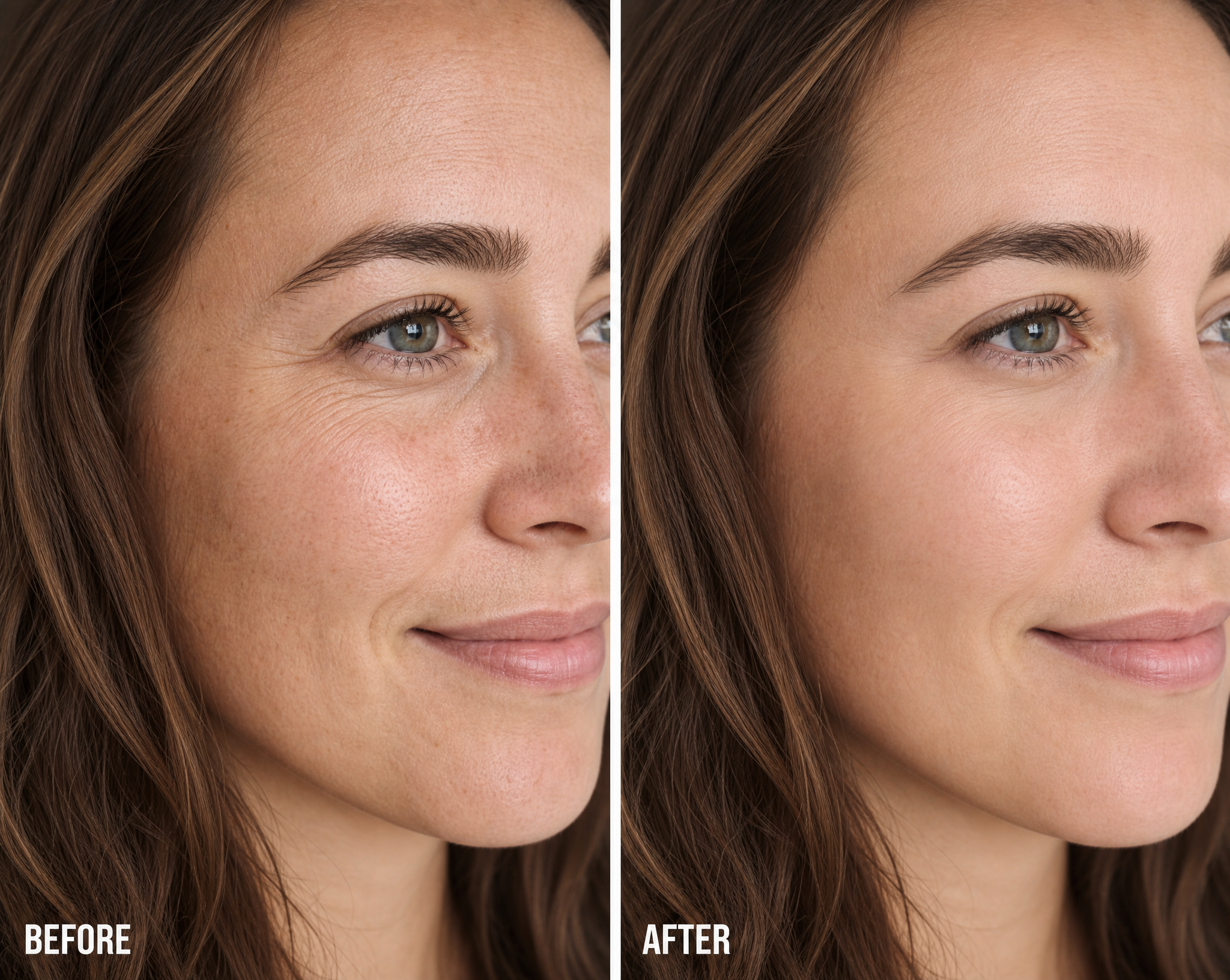
Before-and-after photographs
Medical imagery
Scientific graphics
White coat imagery
Ingredient callouts
Consumer testimonials
Product names
Social media demonstrations
Regulators often evaluate the overall impression created by marketing—not simply the individual words.
A product can create an implied claim even if those exact words never appear on the package.
Ingredients Alone Do Not Prove Claims
One of the biggest misconceptions in cosmetic marketing is believing that simply including an ingredient automatically supports every claim associated with that ingredient.
It doesn't.
Adding niacinamide doesn't automatically prove a product brightens skin.
Adding peptides doesn't automatically prove wrinkle reduction.
Adding ceramides doesn't automatically demonstrate barrier repair.
Even ingredients supported by strong scientific literature must perform within the finished formulation.
Their effectiveness depends on factors such as:
Concentration
Stability
pH
Delivery system
Ingredient interactions
Packaging
Manufacturing process
Consumer usage
Claims should be supported by evidence for the finished product whenever possible—not solely by the reputation of individual ingredients.
What Types of Evidence Support Cosmetic Claims?
Not all evidence carries the same weight.
The type of evidence needed depends on the strength of the claim being made.
A statement such as "leaves skin feeling soft" generally requires less supporting evidence than "reduces the appearance of wrinkles by 32% in four weeks."
The stronger and more specific the claim, the stronger the supporting evidence should be.
Evidence commonly used in cosmetic claims substantiation includes:
Clinical studies
Consumer perception studies
Instrumental measurements
In vitro laboratory testing
Published scientific literature
Supplier technical data
Stability testing
Safety testing
Before-and-after photography
Expert evaluations
Often, the strongest substantiation combines multiple forms of evidence rather than relying on a single source.
Clinical Testing
Clinical studies are among the strongest forms of evidence for cosmetic performance claims because they evaluate the finished product under controlled conditions using human participants.
Depending on the study, researchers may evaluate improvements in:
Hydration
Wrinkle appearance
Skin elasticity
Skin firmness
Smoothness
Brightness
Redness
Oil control
Pigmentation
Consumer satisfaction
Clinical studies often include standardized application protocols, defined evaluation periods, and statistical analysis to determine whether observed improvements are meaningful.
Not every cosmetic product requires clinical testing, but stronger performance claims often benefit from stronger evidence.
Consumer Perception Studies
Not every claim requires specialized laboratory equipment.
Some claims are based on how consumers experience the product.
Participants may be asked questions such as:
Does your skin feel softer?
Does your skin appear smoother?
Does your complexion look brighter?
Would you purchase this product again?
Would you recommend this product?
Results are typically reported as percentages.
Examples include:
94% agreed skin felt softer.
89% reported smoother-looking skin.
91% would recommend the product.
These studies support perception-based claims rather than objective biological changes.
Understanding the difference is important.
Instrumental Testing
Some product benefits can be measured using specialized scientific instruments rather than consumer opinions.
Examples include measuring:
Skin hydration
Transepidermal water loss (TEWL)
Skin elasticity
Sebum production
Skin roughness
Skin color
Wrinkle depth
Skin firmness
Instrumental testing provides objective numerical data that can strengthen performance claims.
When combined with consumer perception studies, it creates a more complete picture of product performance.
In Vitro Testing
Some ingredients are evaluated in laboratory models before they are ever used in finished cosmetic products.
These studies may investigate:
Antioxidant activity
Collagen-related pathways
Anti-inflammatory potential
Enzyme inhibition
Cellular responses
Barrier-related mechanisms
While useful for ingredient research, these studies do not automatically demonstrate that a finished cosmetic product will produce the same results on human skin.
Laboratory findings should not be overstated in consumer marketing.
Published Scientific Literature
Scientific publications can help explain why an ingredient may provide certain benefits.
For example, published research may demonstrate that niacinamide improves barrier function or that glycerin is an effective humectant.
However, published literature generally supports the ingredient—not necessarily your finished formulation.
The finished product may differ in:
Ingredient concentration
Delivery system
Formulation stability
pH
Ingredient compatibility
Consumer usage conditions
Scientific literature is valuable context, but it should not replace testing of the finished product when making specific performance claims.
Supplier Data
Raw material suppliers often provide technical information supporting their ingredients.
This may include:
Clinical summaries
Consumer studies
Instrumental testing
Safety information
Published research
Recommended use levels
Supplier data can be extremely valuable during formulation.
However, brands should remember that these studies were often conducted using the supplier's ingredient under specific testing conditions—not necessarily within your finished product.
Supplier data supports ingredient selection.
Finished product testing supports finished product claims.
Before-and-After Photography
Before-and-after photography can be a powerful way to demonstrate cosmetic performance.
When properly conducted, photography should use standardized:
Lighting
Camera settings
Angles
Facial expression
Background
Distance
Timing
Small changes in lighting or camera angle can dramatically influence perceived results.
For that reason, before-and-after photography should be carefully standardized and representative of typical consumer outcomes.
Testimonials and Reviews
Customer testimonials provide valuable insight into consumer experience.
However, testimonials alone are generally not considered sufficient substantiation for objective performance claims.
For example:
"This moisturizer feels amazing."
This reflects a personal opinion.
In contrast:
"This product increases collagen production."
That is an objective claim requiring scientific support.
Testimonials can strengthen marketing, but they should not replace appropriate evidence.
"Clinically Tested" vs. "Clinically Proven"
These phrases are often confused.
They are not interchangeable.
Clinically Tested simply means the product has undergone some form of clinical evaluation.
It does not necessarily indicate positive results.
Clinically Proven suggests the testing demonstrated meaningful evidence supporting the claimed benefit.
Using these phrases accurately is important because consumers often interpret them differently.
"Dermatologist Tested"
Another commonly misunderstood phrase is "dermatologist tested."
This generally means a dermatologist participated in or supervised some aspect of product testing.
It does not automatically mean:
Dermatologist approved
Recommended by dermatologists
Safe for everyone
Superior to competing products
The specific testing protocol determines what conclusions are appropriate.
Claims Don't Exist Only on the Package
One of the biggest misconceptions among founders is believing regulatory claims only appear on product labels.
In reality, every place your brand communicates contributes to the overall claims profile of your product.
This includes:
Product packaging
Your website
Product detail pages
Amazon listings
Social media posts
Email marketing
Influencer content
Press releases
Advertising
Product videos
AI-generated product descriptions
Customer service responses
Regulators don't evaluate statements in isolation.
They consider the overall impression created by your marketing.
A package may avoid drug claims, but if your website states the product "treats eczema" or an influencer repeatedly markets it as an acne treatment with your knowledge or direction, those communications may also be considered when evaluating your product.
Every piece of marketing should tell the same truthful, evidence-based story.
Common Claims Mistakes
Even well-intentioned brands sometimes make marketing claims that exceed the evidence supporting their products.
Most problems don't begin with bad science.
They begin with enthusiastic marketing.
Understanding the most common mistakes helps protect both consumers and your business.
Assuming Ingredients Automatically Justify Claims
One of the biggest misconceptions is believing that including a trending ingredient automatically allows every claim associated with that ingredient.
For example, adding peptides doesn't automatically justify anti-aging claims.
Adding niacinamide doesn't automatically support claims of brighter skin.
Adding hyaluronic acid doesn't automatically prove 72-hour hydration.
The finished product—not just the ingredient—must support the claims being made.
Making Claims Without Testing
Many brands launch products based solely on supplier literature or published ingredient studies.
While these resources are valuable, they are not always sufficient to support finished product claims.
If your marketing makes measurable performance claims, consider whether the finished formulation has been evaluated under conditions relevant to those claims.
Overstating the Results
Marketing language should accurately reflect the available evidence.
For example:
Instead of:
"Eliminates wrinkles."
Consider:
"Reduces the appearance of fine lines and wrinkles."
Small wording differences can dramatically change how a claim is interpreted.
The goal is not weaker marketing.
The goal is truthful marketing.
Using Scientific Language Incorrectly
Consumers often associate scientific terminology with credibility.
However, phrases like:
Stimulates collagen
Repairs DNA
Rebuilds skin
Restores damaged cells
Heals inflammation
may imply biological or physiological effects that extend beyond cosmetic claims.
Scientific language should always be chosen carefully and supported by appropriate evidence.
Ignoring Implied Claims
Sometimes the words themselves aren't the issue.
The overall marketing message is.
Examples include:
Before-and-after photographs suggesting treatment of a medical condition
White coats implying medical endorsement
Medical imagery
Product names suggesting therapeutic effects
Consumer testimonials describing disease treatment
The overall impression matters just as much as the individual statements.
Claims Review Checklist
Before launching a cosmetic product, ask yourself:
✓ Can we support every claim with appropriate evidence?
✓ Does the finished product support the claim—not just the ingredient?
✓ Are our claims consistent across packaging, website, Amazon listings, and social media?
✓ Are before-and-after photographs standardized and representative?
✓ Have we reviewed implied claims as well as written claims?
✓ Are testimonials being used appropriately?
✓ Does our marketing avoid unintentionally creating drug claims?
✓ Would a reasonable consumer interpret our claims the way we intend?
If any answer is "no," the marketing should be reviewed before launch.
Key Takeaways
Claims substantiation is the process of supporting marketing claims with appropriate evidence.
Stronger claims require stronger supporting evidence.
Ingredients alone do not automatically justify finished product claims.
Clinical studies, consumer perception studies, instrumental testing, supplier data, and scientific literature each have different strengths and limitations.
Cosmetic claims differ from drug claims, and wording matters.
Claims exist everywhere your brand communicates—not just on product packaging.
Before-and-after photographs, testimonials, influencer content, and AI-generated marketing copy all contribute to the overall claims profile of a product.
Honest, evidence-based marketing builds long-term consumer trust and reduces regulatory risk.
Cosmeta's Perspective
The beauty industry often treats marketing and formulation as separate disciplines.
They aren't.
Every formulation decision influences the claims you can responsibly make.
Likewise, every marketing claim should be rooted in the science behind the product.
One of the biggest mistakes brands make is developing marketing first and looking for evidence afterward. The strongest products are developed with substantiation in mind from the beginning. Desired claims influence ingredient selection, formulation strategy, testing plans, and even packaging decisions.
Claims substantiation shouldn't be viewed as a regulatory hurdle.
It should be viewed as a competitive advantage.
Brands that consistently support their claims earn something far more valuable than short-term attention.
They earn credibility.
Consumers remember products that perform.
Retailers value brands they can trust.
Investors recognize businesses built on defensible science rather than exaggerated promises.
At Cosmeta, we believe formulation, testing, and marketing should work together from day one. When science leads the conversation, marketing becomes more authentic, more persuasive, and far more sustainable over the long term.
Ready for the Next Step
Whether you're developing your first product or expanding an established line, planning your claims strategy early can save time, reduce regulatory risk, and strengthen your brand. By aligning formulation, testing, and marketing from the start, you create products that are both compelling and scientifically credible.
FAQs
-
Claims substantiation is the process of gathering scientific or other reliable evidence to support the marketing claims made about a cosmetic product. The stronger the claim, the stronger the supporting evidence should generally be.
-
No. While scientific research on ingredients is valuable, the finished product should support the claims being made. Ingredient concentration, formulation, stability, packaging, and real-world performance all influence results.
-
Cosmetic claims generally relate to cleansing, beautifying, moisturizing, or improving appearance. Drug claims involve treating, preventing, or affecting the structure or function of the body and may trigger different regulatory requirements.
-
Claims are evaluated across the entire marketing ecosystem, including product packaging, websites, retailer listings, advertisements, social media, influencer content, videos, and other promotional materials. Brands should ensure their messaging is accurate and consistent wherever consumers encounter it.