FORMULATION 101: Skincare Product Development: From Concept to Market
The Complete Guide to Turning an Idea Into a Commercially Successful Product
“Great products aren’t discovered in a single breakthrough. They’re built through hundreds of thoughtful decisions.”
Great Products Don't Start in the Laboratory
One of the biggest misconceptions about skincare product development is believing it begins with ingredients.
It doesn't.
Long before a cosmetic chemist weighs the first raw material, successful products are shaped by strategy.
Who is the customer?
What problem are they trying to solve?
Why would they choose your product over the dozens already available?
How should the product feel?
What experience should it create?
What role will it play in your brand?
Only after those questions are answered does chemistry begin.
While every project is unique, most successful skincare products move through the same major development stages before they ever reach consumers. Understanding this journey helps founders make better decisions, establish realistic expectations, and avoid many of the costly delays that occur during product development.
Stage 1: Market Strategy & Product Vision
Every successful skincare product begins with a clear vision.
Before discussing ingredients, it's important to understand exactly what you're building and why.
This stage focuses on defining the business opportunity as much as the product itself.
Questions typically include:
Who is your ideal customer?
What problem are you solving?
What makes your product different?
Where will it be sold?
What price point are you targeting?
What should the customer experience every time they use it?
What claims are important?
How should the product fit within your overall brand?
This is also the time to study the market.
Understanding competitor products, customer reviews, pricing, and existing gaps often reveals opportunities that aren't immediately obvious.
Sometimes innovation comes from creating entirely new technology.
More often, it comes from solving an existing problem better than anyone else.
Another important decision made during this stage is product architecture.
Should this become a serum?
A lotion?
A balm?
A cleansing bar?
A spray?
A stick?
An anhydrous concentrate?
These decisions influence everything that follows, including ingredient selection, packaging, manufacturing, consumer perception, and even regulatory requirements.
Before chemistry begins, the product needs a reason to exist.
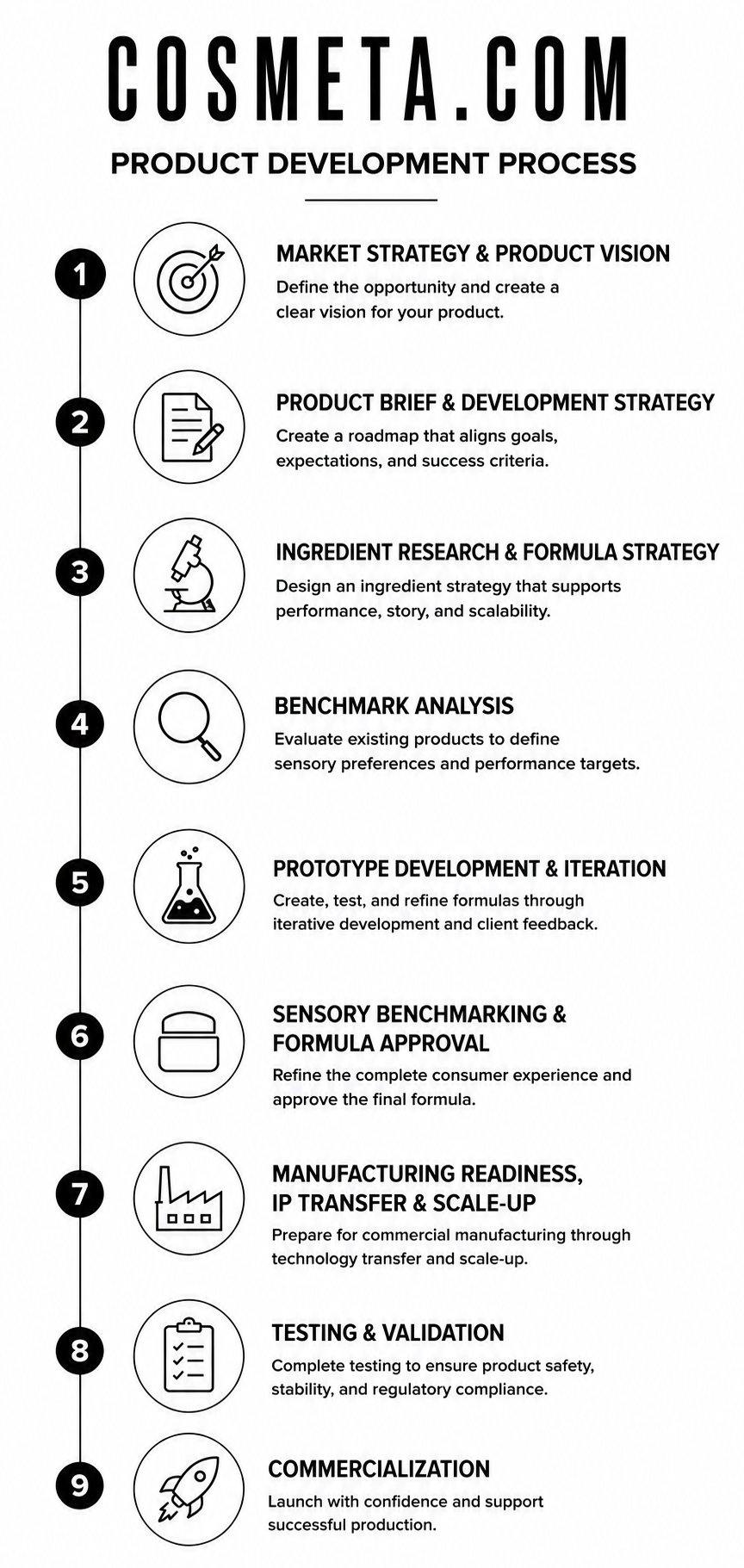
Stage 2: Product Brief & Development Strategy
Once the vision is established, it's organized into a product brief.
A good product brief creates alignment between everyone involved in development.
It doesn't need to be complicated.
In fact, one clear page is often more valuable than a one-hundred-page document.
The purpose isn't to describe every ingredient.
It's to define the project.
A typical product brief includes:
Customer profile
Product objectives
Desired skin feel
Target claims
Brand philosophy
Ingredient preferences
Ingredients to avoid
Packaging direction
Budget considerations
Regulatory considerations
Timeline expectations
Success criteria
If a founder doesn't already have a brief, an experienced formulation partner will usually help develop one.
One of the biggest reasons projects become delayed is because the brief keeps changing.
New ingredients appear every week.
Claims evolve.
The product slowly becomes something different than originally intended.
Product development should absolutely evolve through learning.
It should not become a moving target.
A clear brief gives every future decision a reference point.
Stage 3: Ingredient Research & Formula Strategy
With the strategy established, formulation planning begins.
This stage isn't simply about selecting popular ingredients.
It's about designing an ingredient strategy that supports the product's goals.
Questions now become much more technical.
Should biotechnology improve performance?
Would fermented ingredients support the brand story?
Should multifunctional ingredients simplify the formula?
Would the product benefit from encapsulation or another delivery technology?
Should the formula align with clean beauty standards?
Can the ingredients be sourced consistently?
Will they remain commercially available years from now?
Can the formulation be manufactured efficiently at commercial scale?
This is where experience becomes incredibly valuable.
A cosmetic chemist shouldn't evaluate ingredients in isolation.
Every ingredient should be evaluated through the lens of your customer, your product objectives, your manufacturing strategy, your commercial goals, and your long-term vision.
The goal isn't simply to build an ingredient list.
The goal is to design a formulation strategy.
Staying Ahead of Ingredient Innovation
Ingredient technology changes every year.
Suppliers continually introduce new active ingredients, biotechnology platforms, multifunctional materials, sustainable alternatives, and delivery systems that improve how products perform.
At Cosmeta, staying current isn't optional.
It's an essential part of product development.
We continuously evaluate new ingredient launches, supplier research, scientific literature, and emerging technologies to understand not only what's new—but what has the potential to create meaningful value for our clients.
Not every new ingredient deserves a place in a formulation.
Some quickly disappear.
Others quietly redefine how products are developed for years to come.
Experience helps distinguish between temporary excitement and innovations with lasting commercial potential.
When the right opportunity exists, we introduce those technologies because they improve the product—not because they're fashionable.
Innovation should never exist simply because something is new.
It should create a better experience for the customer while strengthening the long-term position of the brand.
Stage 4: Benchmark Analysis
One of the most valuable tools in skincare product development isn't an ingredient.
It's a benchmark.
Benchmark products allow founders to communicate preferences that are often difficult to describe with words alone.
You may love the lightweight feel of one moisturizer.
The elegant finish of another.
The foam of a cleanser.
The fragrance of a body wash.
The packaging of a serum.
Or perhaps there's a product you absolutely don't want to emulate.
Every benchmark communicates something valuable.
Together, they become one of the most effective communication tools between founder and formulator.
As we often tell clients,
"Benchmarks are a language that speaks when you don't have the words."
The purpose of benchmarking isn't to copy another product.
It's to understand what experiences resonate with you and your customer so they can be translated into something original.
The more thoughtful your benchmarks, the more efficiently your chemist can understand your vision.
Once the strategy, ingredient direction, and benchmark products are aligned, development moves into the laboratory.
Stage 5: Prototype Development
This is where ideas become chemistry.
Most skincare products begin with a theoretical formula designed around the agreed product objectives.
The first laboratory prototype is rarely intended to be the final product.
Instead, it becomes the starting point for discovery.
Every prototype answers questions while creating new ones.
Does it perform as expected?
Does it have the right viscosity?
Does it absorb too quickly?
Does it feel too rich?
Does it foam enough?
Does it manufacture efficiently?
Is the preservation system appropriate?
Does the active ingredient remain stable?
Some formulations perform remarkably well on the first attempt.
Most improve through multiple rounds of refinement.
Each iteration teaches something.
Sometimes improvements are technical.
Sometimes they're sensory.
Sometimes a challenge discovered during development leads to an entirely new approach.
One of the most overlooked skills in cosmetic formulation is recognizing the difference between a failed experiment and an unexpected opportunity.
Some of the most interesting products begin because a formulator asks,
"What if this isn't a mistake?"
Throughout scientific history, many important discoveries began as unexpected observations.
Cosmetic formulation is no different.
Experience explains why something happened.
Curiosity asks whether that unexpected result might actually create a better product.
The objective isn't to finish development as quickly as possible.
The objective is to keep refining until the product truly delivers the customer experience everyone envisioned from the beginning.
Client feedback plays an important role throughout this process.
Each round of evaluation helps determine whether the formulation is moving closer to the original vision or whether additional refinement is needed.
Development continues until both the client and the formulation team agree that the product is ready to move forward.
Stage 6: Sensory Benchmarking & Consumer Experience
A skincare product can be technically perfect and still fail in the marketplace.
Consumers don't purchase products because they understand emulsification systems or polymer chemistry.
They purchase products because of how they feel.
Texture influences perception before performance ever has the chance.
A product that glides effortlessly, absorbs beautifully, and leaves skin feeling elegant creates an emotional connection that customers remember.
During this stage, the formulation is refined to optimize the complete user experience.
Questions become much more subjective.
Should the product feel rich or lightweight?
Should it leave a velvety finish or disappear instantly?
How much playtime should it have during application?
Should it foam quickly or produce a dense luxurious lather?
How should it smell?
How should it look in the package?
How should it feel five minutes after application?
Sometimes these refinements involve ingredient changes.
Other times they involve processing techniques, emulsifier systems, rheology modifiers, or subtle adjustments that dramatically improve the finished product without fundamentally changing the formula.
This is where cosmetic formulation becomes both an art and a science.
Technical performance matters.
Consumer perception matters just as much.
The best skincare products succeed because they deliver both.
By the end of this stage, the formulation should not only perform as intended—it should create an experience customers want to repeat.
With the formulation refined and approved, development shifts toward preparing the product for commercial manufacturing and market launch.
Stage 7: Manufacturing Readiness, IP Transfer & Scale-Up
By this stage, the formulation has achieved its intended performance and sensory profile.
Now the focus shifts from developing the product to preparing it for commercial manufacturing.
This is where many founders discover that creating a great formula and successfully manufacturing a great product are two different challenges.
Packaging becomes an important part of the conversation.
Should the product be filled into an airless pump, squeeze tube, glass bottle, jar, or stick?
Will the packaging protect sensitive ingredients?
Is it compatible with the formulation?
Can the manufacturer efficiently fill it?
Will the package support the desired customer experience?
Packaging isn't simply a branding decision.
It's part of the formulation strategy.
At the same time, manufacturing considerations become increasingly important.
Questions now include:
Can this formulation be produced consistently at commercial scale?
Does the manufacturing facility have the appropriate equipment?
Are the raw materials commercially available with reliable supply?
Can the manufacturing procedure be simplified without compromising performance?
Does the formula meet the target cost of goods?
One of the advantages of involving manufacturing considerations early is that many potential problems can be identified before production begins.
A beautiful laboratory formula that cannot be manufactured efficiently rarely becomes a successful commercial product.
Once the client approves the formulation, complete formulation documentation is prepared.
This typically includes:
Master formulation
Manufacturing procedure
Raw material specifications
Batch calculations
Processing recommendations
Technical documentation required for commercialization
Because every custom formulation at Cosmeta is developed exclusively for the client, intellectual property belongs to the client from the beginning of the project.
Upon completion, the formulation and supporting documentation are transferred to the selected manufacturing partner so production can begin with confidence.
Technology transfer doesn't mean the relationship ends.
Questions often arise during scale-up, and we're available to support manufacturers throughout the commercialization process to help ensure the product performs in production exactly as it did during laboratory development.
Stage 8: Testing & Validation
Developing the formula is only part of the journey.
Before a product reaches consumers, it must demonstrate that it performs consistently over time.
Testing is often the single largest factor influencing product development timelines.
Even when accelerated development methods are used, formulations typically require 4 to 8 weeks of accelerated stability testing before moving toward commercial manufacturing.
Depending on the product category, additional testing may also be recommended or required.
Examples include:
Accelerated stability testing
Preservative efficacy (Challenge Test)
Microbial limits testing
Packaging compatibility
Freeze-thaw stability
Transportation stability
Clinical studies
Consumer use studies
SPF testing
Water resistance testing
Additional OTC validation where applicable
Not every product requires every test.
The testing strategy depends on the product category, intended claims, regulatory requirements, retail channel, and risk profile.
For traditional cosmetic products, formulation is often completed well before testing is finished.
For OTC products—such as mineral sunscreens and acne treatments—additional regulatory requirements and validation studies typically extend the overall development timeline.
This is one reason sunscreen development often takes considerably longer than a standard moisturizer or cleanser.
At Cosmeta, we use a deliberate, risk-based development approach.
The objective isn't simply to complete testing.
It's to identify technical risks as early as possible so they can be addressed before commercial manufacturing.
Stage 9: Commercialization
Once testing is complete and the product is approved for manufacturing, commercialization begins.
This is where months of planning finally become a product customers can purchase.
Commercialization often includes:
First production support
Batch review
Manufacturing troubleshooting
Supplier substitutions when necessary
Production optimization
Technical support
Scale-up assistance
Even the best-developed formulations occasionally require small adjustments during first production.
Raw materials may behave slightly differently at commercial scale.
Mixing equipment varies from manufacturer to manufacturer.
Processing conditions often need refinement.
An experienced formulation partner remains involved to help solve these challenges quickly and maintain product quality.
The goal isn't simply to manufacture a product.
The goal is to manufacture the same product consistently every time.
How Long Does Skincare Product Development Take?
Every project is different, but most cosmetic skincare products can be developed and prepared for commercialization within 6 to 18 months.
The complexity of the formulation is only one part of the timeline.
In many cases, testing—not formulation—is the largest driver of development time.
A typical cosmetic development schedule often looks like this:
Product Strategy & Brief: 1–2 weeks
Ingredient Research & Formula Strategy: 2–4 weeks
Prototype Development & Iteration: 2–4 months
Formula Approval: Varies by project
Accelerated Stability: 4–8 weeks
Commercial Manufacturing Preparation: Varies by manufacturer
Commercial Launch: Following successful validation and production
Projects involving OTC drug products, mineral sunscreens, or products requiring additional clinical validation generally require longer timelines due to additional testing and regulatory considerations.
While every founder wants to launch as quickly as possible, rushing development often creates far greater delays later.
Our philosophy is simple:
Move efficiently.
Reduce technical risk early.
Launch with confidence.
A well-developed product should perform consistently not only in the laboratory, but on the manufacturing floor and ultimately in the hands of your customers.
Common Pitfalls That Delay Product Launch
Most delays in skincare product development aren't caused by chemistry.
They're caused by decisions made throughout the development process.
Understanding these common pitfalls can save months of unnecessary delays and significantly improve the likelihood of a successful launch.
A Moving Target
One of the most common challenges is allowing the project to continually change direction.
A new trending ingredient appears.
Packaging changes halfway through development.
Claims evolve.
A different competitor launches.
The product slowly becomes something different than originally intended.
Successful product development should evolve through learning and testing—not through constantly redefining the objective.
A clear product brief provides a reference point that allows innovation while keeping the project moving forward.
Chasing Trends Instead of Building a Brand
The beauty industry changes quickly.
New ingredients, technologies, and marketing claims appear every year.
Some become lasting innovations.
Many disappear just as quickly.
Founders sometimes feel pressure to incorporate every new ingredient they discover during development.
In reality, the strongest products rarely succeed because they contain the newest ingredient.
They succeed because they solve customer problems exceptionally well.
Trends may create temporary attention.
Thoughtful product development creates lasting businesses.
Waiting Too Long to Think About Manufacturing
A formulation that performs beautifully in a laboratory still needs to perform consistently at commercial scale.
Manufacturing considerations—including equipment capabilities, packaging selection, minimum order quantities, filling methods, and ingredient sourcing—should be considered throughout development rather than after the formulation is complete.
The earlier manufacturing is considered, the fewer surprises occur during commercialization.
Underestimating Testing Requirements
Many founders assume the formulation itself determines the project timeline.
More often, testing becomes the largest driver of commercialization.
Accelerated stability, preservative efficacy testing, packaging compatibility, and other validation studies require time.
Products cannot simply be formulated one week and responsibly launched the next.
Planning for testing from the beginning creates more realistic timelines and fewer unexpected delays.
Product Development Is Rarely Linear
Many founders imagine product development as a straight line.
Idea.
Formula.
Manufacturing.
Launch.
Reality looks very different.
Research.
Develop.
Test.
Learn.
Refine.
Repeat.
Every prototype teaches something.
Every stability study provides information.
Every manufacturing discussion improves the process.
Every round of refinement reduces uncertainty.
Iteration isn't inefficiency.
It's one of the reasons exceptional products outperform average ones.
Some of the most successful formulations weren't created because the first prototype was perfect.
They were created because the development team was willing to continue asking better questions.
Sometimes an unexpected result reveals a better texture.
Sometimes a processing challenge leads to a simpler formula.
Sometimes what initially appears to be a mistake becomes an entirely new product concept.
The best formulators don't simply solve problems.
They recognize opportunities hiding inside them.
The Cosmeta Perspective
Every formulation partner develops products differently.
At Cosmeta, we believe successful product development requires far more than technical formulation expertise.
It requires scientific knowledge, commercial thinking, creativity, and persistence.
Every formulation decision is evaluated through the lens of your goals.
Not simply through ingredient functionality.
We consider your customer.
Your brand positioning.
Your manufacturing strategy.
Your budget.
Your intellectual property.
Your long-term business objectives.
That's what transforms formulation into product development.
We're known for technical formulation, but we're equally passionate about innovation.
Not innovation simply because something is new.
Innovation that creates meaningful value for both the brand and the customer.
We continually evaluate new ingredient technologies, biotechnology platforms, supplier innovation, and emerging scientific research—not to chase trends, but to identify opportunities that genuinely improve products.
Sometimes innovation means discovering a completely new technology.
More often, it means applying existing science in a smarter way.
Simplifying a formulation.
Improving sensory experience.
Borrowing an idea from another product category.
Or solving a problem competitors have simply accepted.
Our experience spans skincare, body care, hair care, mineral sunscreen, OTC products, self-tanning, clean beauty, biotechnology, and emerging ingredient technologies.
That broad perspective allows us to connect ideas across categories and discover opportunities that are often overlooked.
We also believe that the best product development happens through collaboration.
Founders understand their customers.
We understand formulation.
Together, those perspectives create products neither could have developed independently.
Building Products That Last
At Cosmeta, our goal isn't simply to help brands launch products.
It's to help them build products that create a lasting competitive advantage.
The beauty industry moves quickly.
Ingredients trend.
Claims evolve.
Consumer preferences shift.
If your entire strategy is built around responding to what's popular today, you'll often arrive just as the trend begins to fade.
We believe the strongest brands don't simply chase trends.
They recognize meaningful shifts, understand where the industry is going, and create products that remain relevant long after the excitement surrounding a single ingredient or claim has passed.
Whenever possible, we encourage founders to think beyond the next launch.
Can this product become synonymous with a customer need?
Can it establish a new point of view?
Can it redefine an existing category?
Can it create a competitive advantage that's difficult to replicate?
The most valuable innovation isn't always the newest ingredient.
It's the product that customers continue choosing years after it launches.
Our strategy is to help brands create products that build a moat around their business through meaningful innovation, thoughtful formulation, and exceptional customer experience.
Not simply helping brands enter a category.
Helping them define it.
FAQs
-
Skincare product development typically moves from product strategy and briefing into formulation, prototyping, ingredient sourcing, testing, packaging compatibility, scale-up, manufacturing, and commercialization. The exact process depends on the complexity of the product, but the strongest development programs begin by defining the consumer, competitive opportunity, benchmarks, claims, sensory targets, COGS, and regulatory requirements before the first prototype is made.
-
There is no universal timeline. Development depends on formulation complexity, raw-material sourcing, prototype revisions, packaging, stability and compatibility testing, regulatory requirements, manufacturing schedules, and the amount of validation required before launch. A well-defined product brief can accelerate development because the chemist is solving toward a clear commercial target rather than discovering the product strategy through repeated prototypes.
-
You do not need to know cosmetic chemistry or arrive with an ingredient list. It is more valuable to understand who the product is for, the problem it should solve, what makes it different, desired price point, benchmark products, sensory expectations, intended claims, ingredient or retailer standards, and where it will be sold. A formulation partner can then translate those commercial objectives into the appropriate ingredients, percentages, formulation architecture, testing, and manufacturing requirements.
-
Testing depends on the formula, packaging, claims, intended market, and product risk profile. Development may include stability testing, packaging compatibility, microbial testing, preservative efficacy or challenge testing for applicable products, and claims or consumer testing when needed. Testing should be planned as part of development rather than treated as a final box to check because results can affect the formula, package, manufacturing process, and launch claims.
-
Product development does not necessarily end with the first manufacturing run. Brands may later need to change manufacturers, replace a discontinued raw material, improve performance, optimize COGS, or incorporate new ingredient technology. Cosmeta provides 100% ownership of the finished quantitative formula, giving the brand control over ingredient percentages and greater flexibility to manufacture, scale, reformulate, and evolve the product as the business grows.