FORMULATION 101: What the Heck Is a Cosmetic Product Brief?
How to Write One Without Overthinking It
“A product brief doesn’t limit creativity. It gives innovation a direction.”
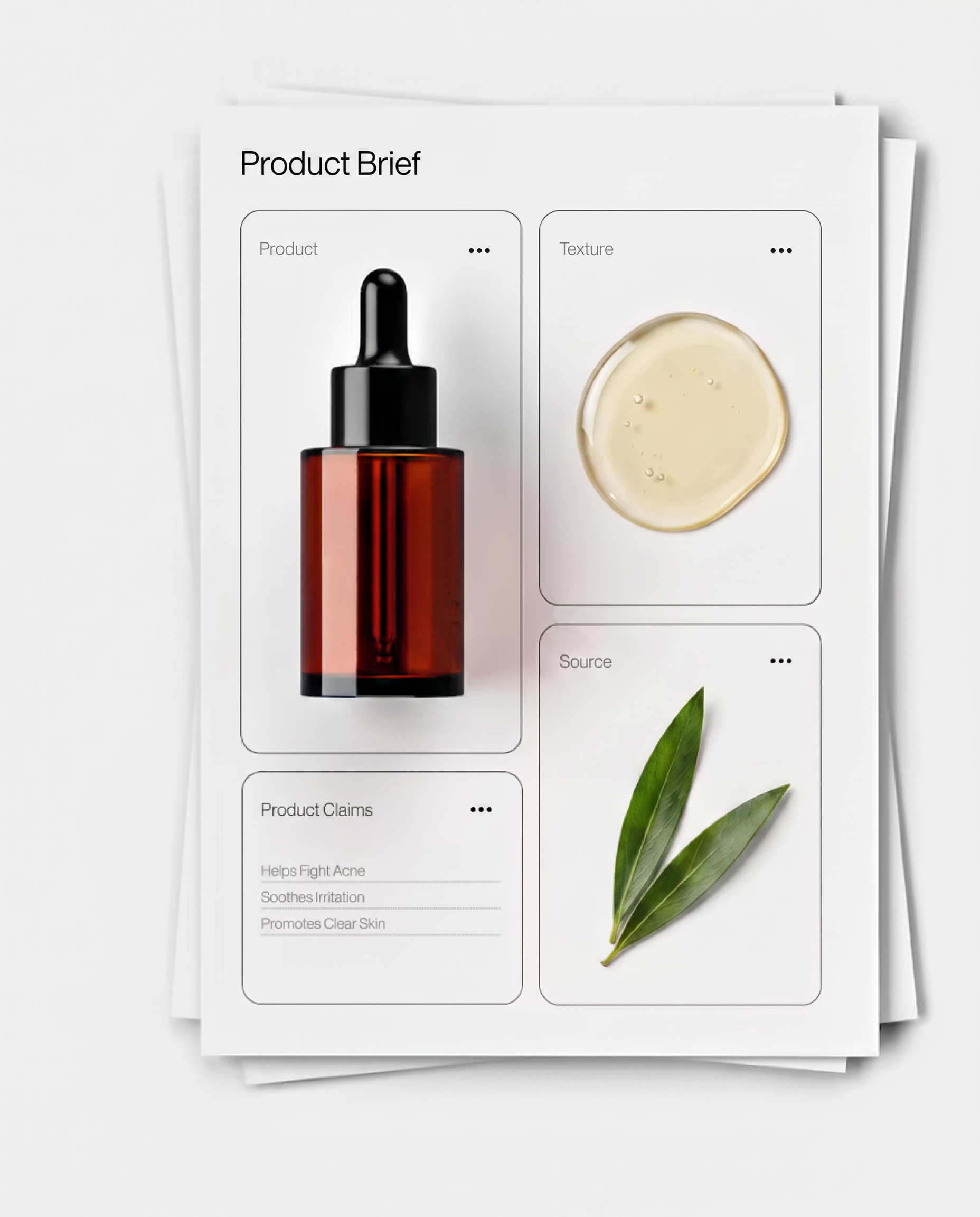
Most Founders Think They Need All the Answers
One of the biggest misconceptions in product development is believing you need to know exactly what you want before hiring a cosmetic chemist.
You don't.
In fact, most founders come to me with a vision, not a formula. That's exactly how it should be.
Your job isn't to know cosmetic chemistry.
It's to know your customer.
A cosmetic product brief simply helps bridge those two worlds.
Think of It as a Conversation Starter for Alignment
Many people imagine a product brief as a technical document full of ingredient lists, manufacturing specifications, and every possible detail.
It isn't.
A good brief simply answers one question:
What are we trying to create?
Everything else grows from there.
Think of your brief as the starting point for a conversation, not the final blueprint.
Start With the Customer
Before you think about ingredients, think about people.
Who is this product for?
What problem are they trying to solve?
What do they value?
How should they feel when they use it?
The clearer you are about your customer, the easier it becomes to make formulation decisions.
Your customer should guide almost every choice that follows.
Describe the Experience
Rather than focusing on ingredients first, describe the experience you want to create.
Should it feel lightweight or rich?
Fast absorbing or intentionally nourishing?
Should it leave a glow or a matte finish?
Should it foam?
Should it rinse clean?
Should it feel luxurious, refreshing, protective, or barely noticeable?
The sensory experience often becomes the reason consumers repurchase a product.
Include Benchmark Products
One of the most valuable things you can include in your brief isn't a paragraph.
It's a product.
Better yet, several products.
Benchmark products help your chemist understand your preferences in ways words often can't.
Tell them exactly what you like.
"I love this texture."
"I hate how greasy this feels."
"I wish this fragrance was softer."
"I love the packaging."
"I want this finish but better hydration."
These observations become incredibly valuable during development.
Define Your Non-Negotiables
Not every request carries the same importance.
Identify the things that absolutely cannot change.
For example:
Must Have
Fragrance-free
Vegan
Mineral sunscreen
Silicone-free
Pregnancy-friendly
Nice to Have
Cooling sensation
Natural fragrance
Blue color
Airless packaging
Knowing your non-negotiables allows your chemist to make better decisions when inevitable tradeoffs arise.
A Great Brief Evolves. The Scope Shouldn't.
Every successful formulation project evolves.
That's normal.
You may discover an exciting new ingredient technology.
A prototype may inspire a better texture.
Your chemist may recommend a more elegant emulsifier, preservative system, or delivery technology.
Those are healthy refinements.
What slows projects down is when the entire vision changes every few weeks.
One week the product needs to be fragrance-free.
The next week fragrance becomes essential.
It starts as a luxury moisturizer.
Then it becomes a medical-inspired treatment.
Then it needs to be all-natural, microbiome-friendly, reef-safe, vegan, preservative-free, silicone-free, and retail for $18.
At that point, you're no longer refining the project.
You're creating a completely different one.
The best projects have a stable foundation.
Know your customer.
Know the problem you're solving.
Know your budget.
Know your non-negotiables.
Within those boundaries, allow the chemistry to evolve.
That's where innovation happens.
Think of your product brief as defining the destination, not every turn along the journey.
Be flexible about how you get there.
Be confident about where you're going.
Think Beyond the Formula
A great product brief isn't only about ingredients.
It should also answer practical business questions.
Where will the product be sold?
What is your target retail price?
Do you already have a manufacturer?
Will the product launch internationally?
Are there certifications you hope to achieve?
What packaging do you envision?
What is your target launch date?
These decisions influence formulation just as much as ingredient selection.
Don't Overthink It
One of the biggest mistakes founders make is believing they need to write the perfect product brief before contacting a cosmetic chemist.
You don't.
If you've already created a brief, resist the temptation to turn it into a 100-page document. In most cases, a single page is all that's needed to communicate your vision.
The purpose of a product brief isn't to answer every possible question.
It's to provide enough direction for your chemist to begin asking the right ones.
If you don't have a brief at all, that's perfectly okay.
Many cosmetic chemists, including our team at Cosmeta, will develop a project brief with you during discovery or create an internal development brief to guide the formulation process.
That's a normal part of product development.
The most important thing isn't having a perfect document.
It's having a clear vision.
A good chemist can help organize the details.
They can't create your vision for you.
What Every Great Product Brief Should Answer
A strong product brief can often fit on a single page.
It should simply answer the questions that matter most.
What product are you creating?
Who is your customer?
What problem does it solve?
How should it feel?
What benchmark products inspire you?
What are your non-negotiables?
Are there ingredients you want or want to avoid?
What claims are important?
What is your target retail price?
Where will the product be sold?
What does success look like?
If you can answer those questions, you've already given your chemist an excellent foundation.
The Cosmeta Perspective
At Cosmeta, we don't expect founders to arrive with a perfect product brief.
Some clients bring a polished one-page document.
Others bring a few benchmark products, a Pinterest board, and an exciting idea.
Both are perfectly acceptable places to begin.
Our job is to organize your vision, ask the right questions, challenge assumptions when appropriate, and create a clear roadmap for development.
The product brief isn't about locking every decision in place.
It's about establishing a shared vision so everyone is moving toward the same destination.
Because the best formulation projects aren't the ones that never change.
They're the ones where the vision stays clear while the chemistry continues to improve.
FAQs
-
A cosmetic product brief is the strategic blueprint for a new skincare, hair care, body care, or personal-care product. It defines what the product should do, who it is for, how it should feel, target claims, benchmark products, ingredient preferences or exclusions, packaging, price point, regulatory markets, and other commercial requirements. A strong brief gives the cosmetic chemist a clear target before formulation begins.
-
At minimum, define the target consumer, product type, primary benefit, desired texture and sensory experience, benchmark products, key claims, ingredient preferences, certifications or retailer standards, target retail price, packaging direction, and intended markets. You do not need to know the chemistry. A good formulation partner should translate the commercial vision into technical formulation requirements.
-
No. Founders often arrive with trending ingredients in mind, but choosing the right ingredients, forms, percentages, delivery systems, and supporting formulation architecture is part of the chemist's job. It is usually more useful to explain the benefit you want to deliver and the consumer you want to serve than to arrive with a predetermined ingredient list.
-
Without a clear brief, formulation can become an expensive cycle of making prototypes and deciding afterward what the product is supposed to be. Defining positioning, benchmarks, sensory targets, claims, COGS, ingredient philosophy, packaging, and regulatory requirements first gives each prototype a specific objective. The first prototype should test a strategy, not help you discover one.
-
Yes. Product development is iterative, and testing may reveal a better texture, ingredient strategy, package, claim, or commercial opportunity. The brief should provide direction without preventing intelligent changes. With custom formulation and 100% formula ownership, the brand can continue refining the quantitative formula and ultimately control how the product evolves as consumer needs, costs, suppliers, and market opportunities change.